By the Cemex Ventures Investment Team
Capital is not just back in ConTech. It is accelerating. Q3 2026 closed with $7.541B invested across 92 transactions, a 303% increase in invested capital and a 20% increase in deal count compared with Q3 2025. It is, by a wide margin, the strongest quarter we have tracked this year.
Headline figures, however, only tell part of the story. Autodesk’s $3.6B acquisition of MaintainX accounts for almost half of the quarter’s volume on its own. That is why, as we do every quarter, our Investment Team has looked beneath the surface. Excluding that transaction, ConTech still attracted $3.941B across 91 deals, up 111% year-on-year. In other words, the underlying market more than doubled. To put that in perspective, Q3’s underlying volume alone exceeds the $2.884B deployed across the whole of H1 2026, as reported in our Q2 & H1 2026 analysis.
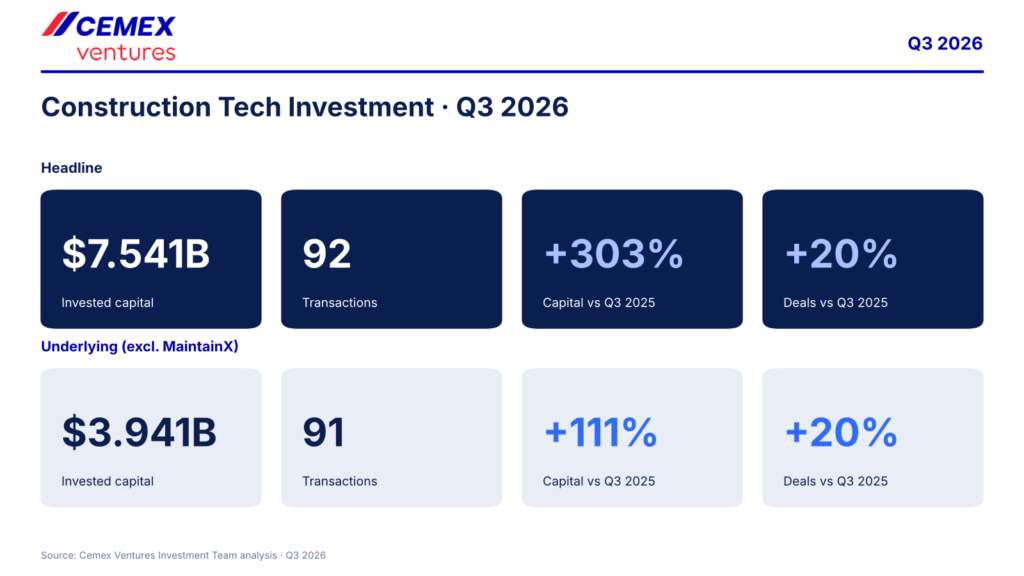
Q3 2026 at a Glance: A $7.5B Headline and a $3.9B Reality Check
The rebound extends well beyond a single landmark transaction. With or without MaintainX, Q3 2026 shows a significantly more active investment environment: more deals than a year ago, and far more capital behind them.
Unless stated otherwise, all figures from this point onwards exclude the MaintainX acquisition, so that the analysis reflects the real dynamics of the ConTech market rather than one exceptional strategic move.
” The real story of Q3 is not the size of the biggest deals, but the breadth of activity beneath them. Capital more than doubled year-on-year even excluding MaintainX, indicating a healthier funding environment across the sector. While signs point a positive trend, higher interest rates and persistent inflation risks may temper investor enthusiasm in the coming quarters, reinforcing a flight toward quality and concentrating capital around the strongest teams, technologies, and business fundamentals ” — Miguel Carralón, Venture Investments & Partnerships at Cemex Ventures
Concentration at the Top: Mega-Deals Shape the Quarter Investment volume remained highly concentrated in a small number of very large transactions. MaintainX alone represented roughly 48% of headline Q3 capital. Two further deals amplified the quarter: Motive’s $1.3B growth financing and Procore’s $845M acquisition of DroneDeploy. Together, these two transactions account for more than half (54%) of the $3.941B underlying volume.
The rest of the top 10 confirms the appetite for proven category leaders and deep-tech bets alike: Mariana Minerals ($310M Series B), Gravis Robotics ($200M), Buildots ($130M), ICON (115𝑀), TerraFirma (100M), NavVis ($85M Series D) and P-1 AI ($50M). Excluding MaintainX, the remaining nine deals of the top 10 add up to $3.135B, close to 80% of underlying volume.
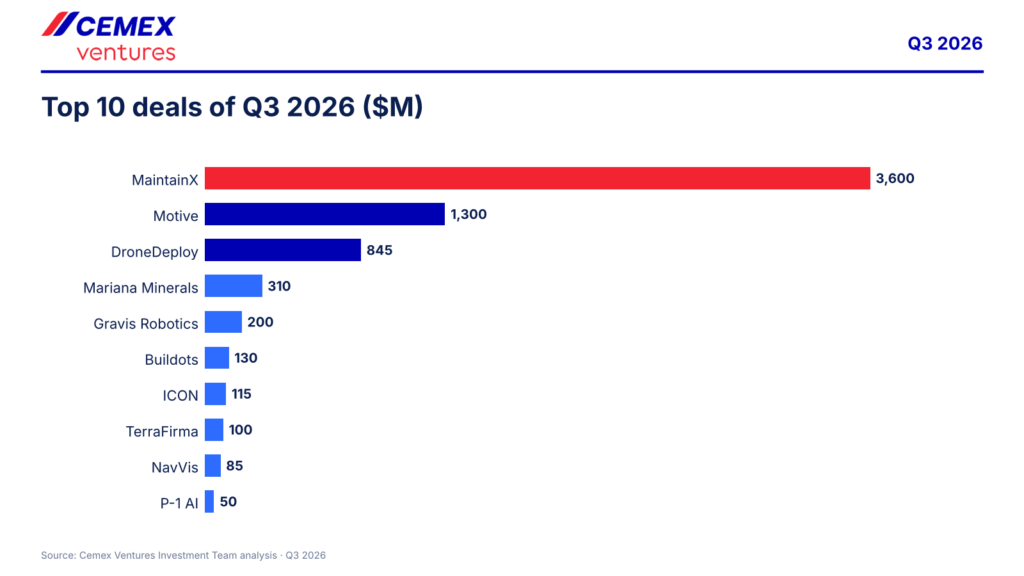
Capital is becoming increasingly concentrated around proven winners. Investors are willing to deploy substantial amounts of capital behind companies that combine strong growth, market adoption, scalable business models, and the potential to redefine established construction workflows and business models.
“Large rounds like these send a clear message to the ecosystem: when a construction technology company proves it can scale, there is now capital ready to back it at a size we simply did not see two or three years ago. The challenge for the rest of the market is that the bar to reach that stage has never been higher.” — Jose Antonio Brunet, Leader at Cemex Ventures
Where the Capital Went: Focus Areas in Q3 2026
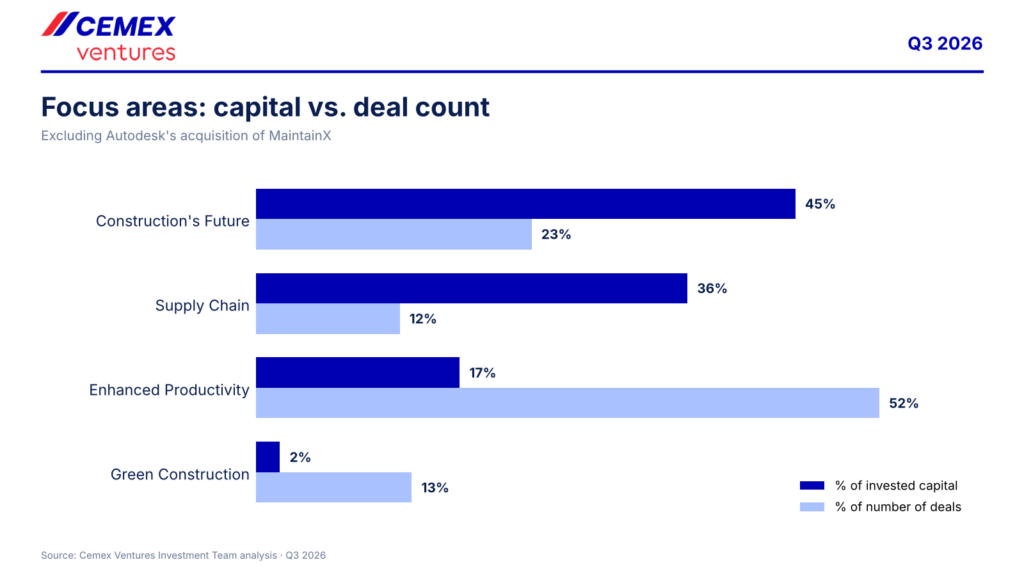
At Cemex Ventures, we analyze the market through our four focus areas: Green Construction, Supply Chain, Enhanced Productivity and Construction’s Future. In Q3, the picture changes significantly depending on whether we look at capital or at deal count.
Construction’s Future: Where the Big Checks Land
Construction’s Future was the largest destination for capital, attracting 45% of Q3 investment volume, while representing 23% of transactions. This is the area that brings together AI, robotics, autonomy, reality capture and advanced digital capabilities, the technologies that will define how construction is executed in the next decade. Rounds such as Gravis Robotics, Buildots, ICON and NavVis illustrate how investors are concentrating larger checks around companies connecting the digital and physical layers of construction.
Supply Chain: Capital Follows Scale
Supply Chain captured 36% of invested capital with just 12% of deals, the highest capital-per-deal ratio of any focus area. Large transactions in fleet operations, materials and industrial logistics pushed this category well above its weight in deal count, confirming the trend we already highlighted in H1: supply chain digitization is no longer a niche, it is a strategic priority.
Enhanced Productivity: The Broadest Base of Activity
Enhanced Productivity represented 52% of all transactions, but only 17% of capital. Productivity solutions (project management, field execution, estimating, scheduling, document intelligence) continue to generate the broadest startup and investor activity, typically through smaller, earlier rounds. This is where much of the sector’s entrepreneurial energy sits, and where many of tomorrow’s category leaders are likely being funded today.
“The gap between deals and dollars in Enhanced Productivity is not a weakness, it is a pipeline. More than half of the quarter’s transactions are in this space, mostly at early stage. Many of these companies are solving very concrete problems on the jobsite, and the ones that build real defensibility around data and workflows will be the growth rounds we see in two or three years.” — Miguel Carralón, Venture Investments & Partnerships at Cemex Ventures
Green Construction: Still Waiting for Its Catalyst
Green Construction attracted just 2% of capital, despite accounting for 13% of deals. Activity is there: founders keep building and investors keep backing them at early stage. But large checks remain elusive. Decarbonization technologies in construction often require longer validation cycles, heavier capital expenditure and, in many cases, a regulatory or pricing signal that makes adoption economically compelling.
“We see a lot of high-quality green construction startups, but most of them are still proving their technology at industrial scale, and that naturally keeps ticket sizes small. The inflection point will come when regulation and carbon pricing turn decarbonization from a ‘nice to have’ into a cost of doing business. When that happens, the capital will move quickly, and the companies already validated with industry partners will be best placed to capture it.” — Jose Antonio Brunet, Leader at Cemex Ventures
Geography: North America Captures 80% of Capital
North America strengthened its dominance significantly, attracting 80% of invested capital and 46% of Q3 transactions. Europe represented only 13% of capital but 35% of deals, while Asia & Oceania accounted for 15% of transactions and just 3% of capital. The Middle East contributed 4% of capital and 3% of deals, and LATAM and Africa did not register disclosed activity this quarter.
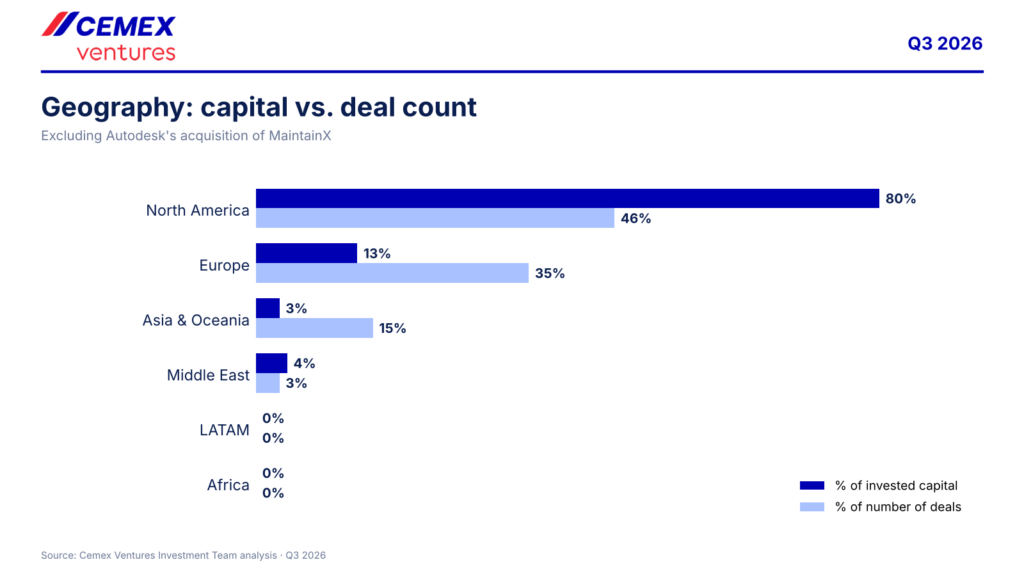
Translated into average ticket sizes, the contrast is striking. An average North American deal in Q3 was around $75M, compared with roughly $16M in Europe and below $10M in Asia & Oceania.
North America dominates capital deployment and large-scale funding, while Europe and APAC contribute a meaningful share of deal formation at much smaller ticket sizes. The gap is not about the quality of entrepreneurs. It reflects the depth of growth-stage capital available in each market and the size of the domestic construction and infrastructure opportunity.
“Europe is producing a third of the deals in ConTech, which says a lot about the quality of its founders. What it still lacks is the growth capital to keep its best companies scaling from Europe. That is precisely where corporate investors can make a difference, by combining capital with access to real projects, real customers and real data.” — Miguel Carralón, Venture Investments & Partnerships at Cemex Ventures
Stage Distribution: A Barbell-Shaped Market
Early-stage investment remained the backbone of the ConTech market. Of the 91 transactions, 63 were completed between Pre-Seed and Series A, equivalent to 69% of total deal activity. Series B accounted for 10 transactions (11%), no Series C rounds were recorded, three deals were late stage (3%), six were M&A (7%) and nine fell into other categories (10%).
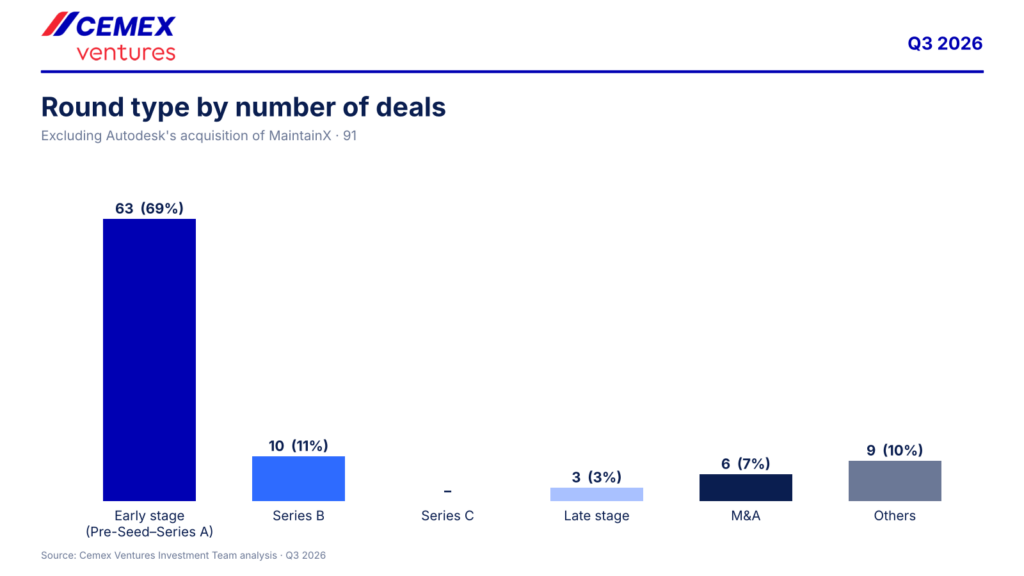
This combination of strong early-stage activity and a handful of very large transactions points to an increasingly barbell-shaped market. Investors continue to place numerous bets on emerging technologies, while concentrating larger amounts of capital in a relatively small group of proven category leaders. The middle of the curve, especially Series C, remains thin, and this is where the “Series B to growth” gap could become a key challenge for many startups in 2027.
” The absence of Series C rounds this quarter highlights a challenge that has long characterized the ConTech ecosystem: the path from early traction to large-scale adoption remains difficult. Early-stage capital continues to flow, but many startups struggle to bridge the gap between raising a Series A or B and reaching the level of revenue, customer penetration, and repeatable growth required to attract later-stage investors. For founders, the message remains clear: technology alone is not enough. ” — Jose Antonio Brunet, Leader at Cemex Ventures
The M&A Signals: Autodesk, MaintainX and the Move Into Operations
M&A and consolidation continued to shape the sector, with six M&A transactions recorded during Q3. The most significant was Autodesk’s $3.6B acquisition of MaintainX, a deal we already flagged as a landmark signal in our H1 report. Its size materially distorts the quarter’s headline figures, which is why we analyze it separately from core ConTech activity.
From a broader industry perspective, the transaction illustrates growing strategic interest in extending construction technology beyond design and project execution into operations, maintenance, asset management and industrial workflows. Procore’s acquisition of DroneDeploy points in a similar direction: platforms are moving to own more of the asset lifecycle and the data generated on it, from reality capture to day-to-day operations.
Q3 therefore provides further evidence of the convergence between traditional ConTech and the wider industrial technology ecosystem.
“What we are seeing is that the boundaries of ConTech are expanding. The value is no longer only in how we design and build an asset, but in how we operate and maintain it for decades. Acquirers are paying for that continuity of data, and that opens very interesting exit paths for startups working across the full lifecycle.” — Miguel Carralón, Venture Investments & Partnerships at Cemex Ventures
The AI Layer: 69% of Deals, and Holding
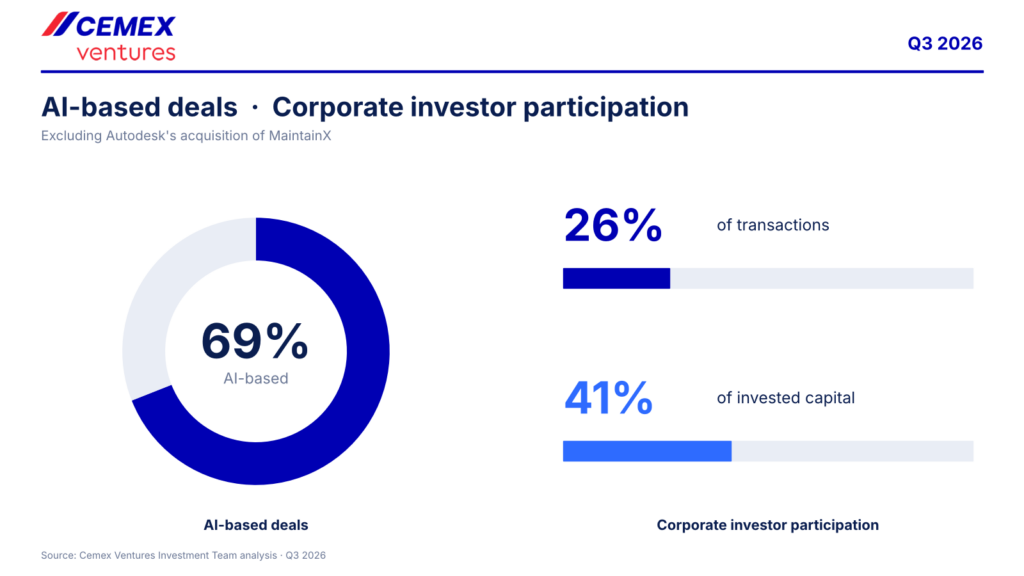
Artificial Intelligence has moved from an emerging investment theme to a foundational layer of ConTech. Approximately 69% of Q3 transactions involved AI-based or AI-enabled companies, broadly maintaining the roughly 70% penetration observed during H1 2026.
Importantly, AI activity is no longer concentrated in a single technology category. It increasingly underpins design and engineering, project management, field intelligence, robotics, autonomous equipment, reality capture and operational optimization. The consistency of this figure across 2026 suggests that AI is becoming a structural characteristic of the ConTech investment landscape rather than a temporary investment cycle.
“In our H1 report, we said the question was no longer whether a startup uses AI, but how central AI is to its defensibility. Q3 confirms it. With seven out of ten deals involving AI, the differentiator is now proprietary data, deep integration into construction workflows and measurable impact on productivity, safety or emissions.” — Jose Antonio Brunet, Leader at Cemex Ventures
Corporate Investors: Fewer Deals, Bigger Checks
Corporate investor participation moderated compared with the first half of the year but remained highly relevant. Corporates participated in 26% of Q3 transactions, versus 37% in H1, while accounting for 41% of total invested capital.
This gap between deal participation and capital deployed highlights the significant weight of strategic investors in larger funding rounds and their continued commitment to the ConTech ecosystem. Corporates are being more selective about where they enter, but when they do, they are doing it with conviction.
“Corporate venture capital brings something to construction that financial capital alone cannot: the industry itself. Access to plants, jobsites, supply chains and customers is often what turns a promising pilot into a scalable business. The fact that corporates are present in 41% of the capital deployed this quarter shows that strategic investors are not stepping back, they are concentrating their bets.” — Miguel Carralón, Venture Investments & Partnerships at Cemex Ventures
Macro Outlook: Stable Today, Headwinds Ahead
VC activity in ConTech remains stable, but the macro environment deserves close attention. Looking ahead, higher interest rates could introduce new headwinds for both VC investment and M&A activity over the coming quarters. A higher cost of capital typically reduces investors’ appetite for risk, puts pressure on startup valuations and makes fundraising more challenging, particularly for later-stage companies that require larger capital commitments.
For a market that already shows a thin middle layer between Series B and late stage, this is a factor that could accentuate the selectivity we are already observing.
“Construction has always been cyclical, and ConTech investors know it. If rates stay higher for longer, we expect valuations to adjust and fundraising timelines to stretch, especially at growth stage. But the structural drivers, from labor shortages to decarbonization and the infrastructure and data center buildout, are not going away. Disciplined companies with real traction will keep finding capital.” — Jose Antonio Brunet, Leader at Cemex Ventures
What Q3 2026 Tells Us About the Road Ahead
Q3 2026 marks a turning point in the ConTech investment cycle. Here are our key takeaways:
- The rebound is real, not just a headline. $7.5B in invested capital, and $3.9B excluding MaintainX, with underlying capital deployment still up 111% year-on-year.
- Capital is concentrating at the top. A small number of mega-deals drive investment volume, while nearly 70% of transactions remain early-stage.
- AI is now structural to ConTech. 69% of Q3 deals involved AI-enabled companies, in line with the exceptionally high penetration observed during H1.
- North America leads capital, Europe and APAC lead deal formation. North America captured 80% of invested capital, while Europe and APAC maintained meaningful activity at substantially smaller ticket sizes.
- ConTech is expanding into operations. M&A activity shows strategic buyers moving beyond design and construction into the full asset lifecycle.
- Green Construction still needs a catalyst. Deal activity is healthy, but capital will follow only when regulation and economics align.
- The macro picture calls for discipline. Higher interest rates could become a headwind for VC and M&A activity in the coming quarters.
At Cemex Ventures, we will keep tracking every quarter to help founders, investors and industry partners understand where construction innovation is heading, and we will keep backing the startups that are building it.
The next wave of construction innovation is not slowing down. It is scaling up. Meet the Construction Startup Competition Finalist here