Table of Contents
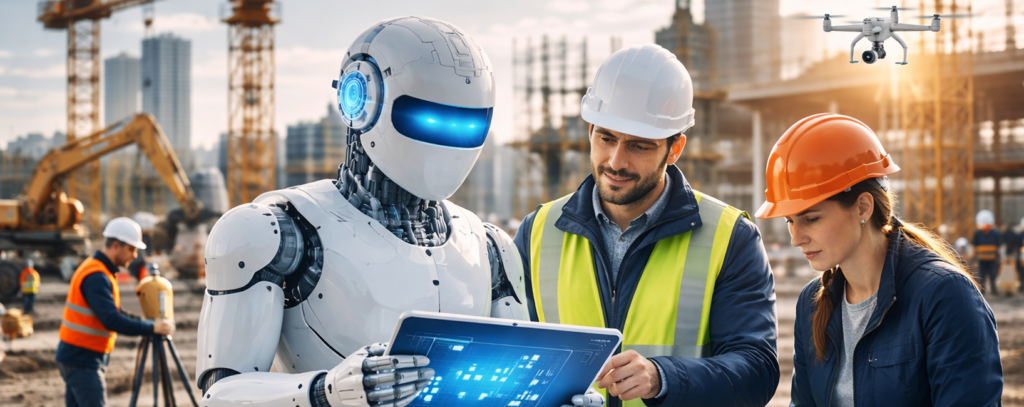
If you’ve been following our content, you know the construction industry is undergoing an unprecedented transformation. Digitalization, automation, and sustainability have become essential pillars to tackle today’s challenges: reducingcosts, improving energy efficiency, ensuring safety, and accelerating execution to meet the growing demand for housing.
In this context, an inevitable question arises: How far can Artificial Intelligence (AI) go in construction?
The answer is no longer a futuristic mystery but a fact backed by numbers: the global AI in construction market is projected to reach USD 11.1 billion by 2025 and grow to USD 24.3 billion by 2030, with a compound annual growthrate (CAGR) of nearly 17%. Moreover, over 50% of companies already use AI-powered drones for topographic surveys, while up to 40% report reduced project delays thanks to predictive intelligence.
AI is constantly redefining construction processes, from design to execution. But can it really build a building on its own? What role does it play in planning, execution, and everyday decision-making? Let’s find out.
Smart Construction: The New Paradigm
Smart Construction is much more than a buzzword. It’s about integrating advanced technologies such as AI, IoT, BIM, robotics, and 3D printing to optimize every stage of a project’s lifecycle. The goal? To make construction more efficient, safer, and sustainable.
- Efficiency: Reduce time and costs through automation and predictive analytics.
- Sustainability: Optimize designs to minimize waste and lower carbon footprint.
- Safety: Real-time monitoring to prevent accidents and improve working conditions.
We are entering the era of Construction 4.0, where data and artificial intelligence are as critical as cement and steel.
Real Applications of AI in Construction
AI is not just about robots or virtual assistants. It’s a powerful tool already present in multiple areas of the industry:
Generative Design
Using advanced algorithms, AI can create hundreds of optimized design variations based on criteria such as cost, energy efficiency, aesthetics, and regulations. Tools like Autodesk Generative Design allow exploring solutions that previously required weeks of manual work.
Predictive Planning
Did you know delays and cost overruns are among the biggest challenges in construction? AI analyzes historical data, weather conditions, and resource availability to anticipate problems and propose solutions, reducing risks and improving schedule management.
Risk and Safety Management
Through computer vision and IoT sensors, AI detects unsafe behaviors on-site, identifies hazardous zones, and sends real-time alerts, preventing accidents before they happen.
Quality Control
AI inspects materials and structures using cameras and drones, detecting defects that might go unnoticed by the human eye. This ensures higher standards and reduces repair costs.
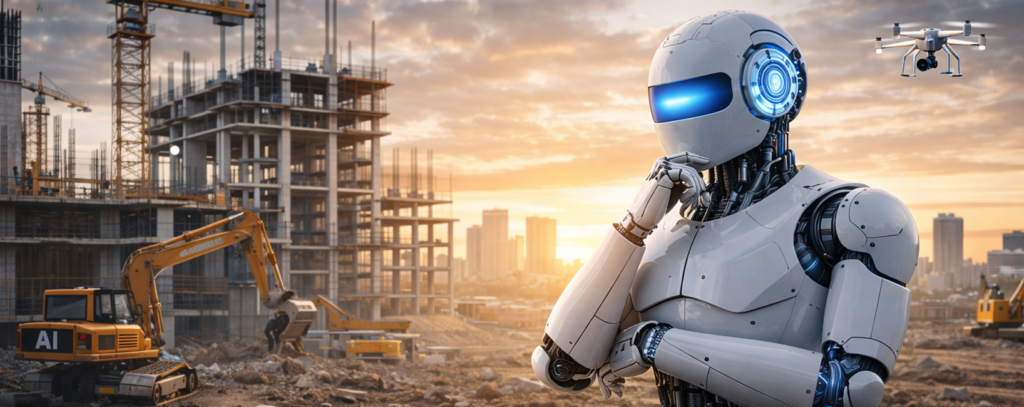
Can AI Build a Building on Its Own?
Today, technologies exist that facilitate planning, execution, and project completion:
- Bricklaying Robots: Machines like SAM100 lay bricks with precision and speed.
- 3D Printing: Startups such as COBOD, in partnership with CEMEX, have built the first 3D-printed building in Europe.
- Drones: Monitor construction sites, generate 3D maps, and track progress.
However, some tasks still require human intervention, such as complex decision-making and coordination with clients, suppliers, and authorities. AI doesn’t replace human interaction it complements it.
AI can automate much of the process, but human supervision is still essential to ensure quality, safety, and regulatory compliance.
Real Cases and Trends
- COBOD & CEMEX – 3D Printing
In collaboration with COBOD, a leader in 3D printing, CEMEX developed the D.fab mix, compatible with conventional concrete. Thanks to this innovation, homes have been printed in Angola and other countries, reducing time and costs compared to traditional methods.
- Modulous – Smart Modular Construction
This UK-based startup leverages AI, BIM, and industrialized construction to deliver prefabricated modules ready for assembly. Its digital platform optimizes design, logistics, and supply chain, cutting time by up to 12% and significantly reducing costs.
- Gravis Robotics – Earthmoving Robotics
Winner of the Construction Startup Competition 2025, Gravis develops intelligent robotic systems for tasks such as excavation and site preparation.
- NavLive – Real-Time 3D Capture
This solution scans spaces and generates instant 3D models on-site, speeding up early design and construction phases.

Trends Toward 2030
It’s estimated that over 40% of construction tasks will be automated, with AI playing a key role in planning and sustainable design. The global AI in construction market could reach USD 24.3 billion by 2030.
Challenges and Opportunities
Challenges
- Regulation: Standards to ensure safety and quality.
- Ethics: Responsible use of data and algorithms.
- Labor Impact: Tech training for the current workforce.
Opportunities
- Sustainability: Optimized designs to reduce waste.
- Efficiency: Fewer errors and cost overruns.
- Innovation: New business models driven by technology.
Final Thoughts
Can AI build a building entirely on its own? Not yet—but projects like the West End in Atlanta aim to make it a reality, marking a milestone in modern architecture. AI is transforming how we build. From generative design to 3D printing, AI is paving the way for smarter, safer, and more sustainable construction.
The question isn’t whether AI will replace humans, but how we will work together to build the future.
What do you think?