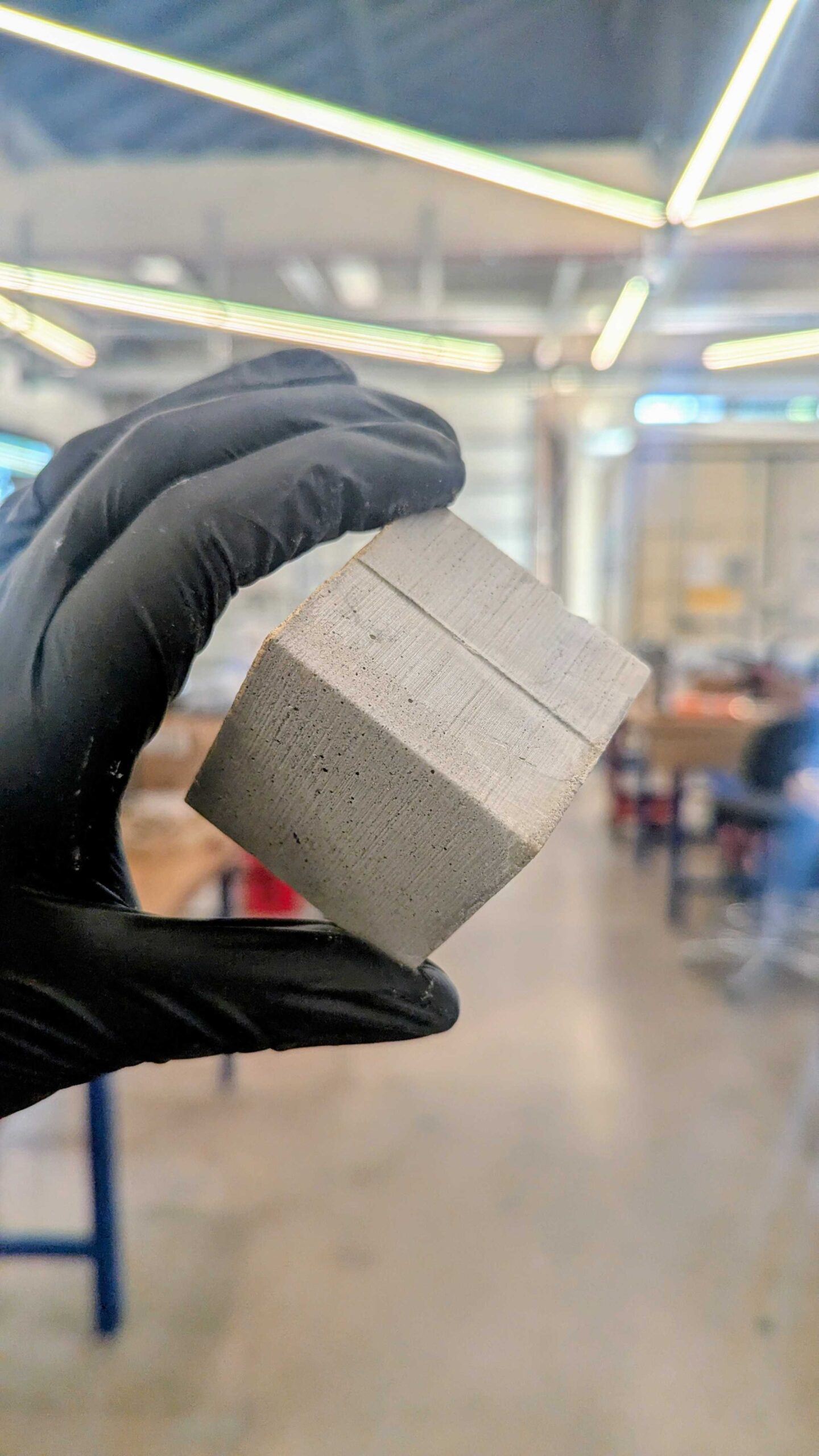
Tikal Industries is a Chicago-based cement manufacturing company solving the fundamental barrier to green cement adoption: economics. While alternative cement technologies have raised millions in funding, market penetration remains low because sustainable options cost more than traditional Portland cement. Tikal is the first company to make low-carbon cement cheaper than the incumbent product, without subsidies or carbon credits, but through superior business model design.
Our production process converts industrial waste streams rich in calcium, silica, and alumina (such as industrial sludge, electronics waste, and mine tailings) into ASTM-compliant cementitious materials. Unlike traditional manufacturers who must purchase limestone feedstock, we get paid to accept waste materials through disposal fees. This dual-revenue model (waste offtake fees + cement sales) creates structural cost advantages that persist at every scale, enabling us to sell cement 25% cheaper than Portland cement while generating 34% profit margins.
What makes this possible is our proprietary technology that eliminates traditional limestone calcination through novel binder formulation and low-temperature activation chemistry, achieving up to 94% CO2 emissions reduction compared to OPC. BlueCem and BlueSCM deliver equivalent performance in compressive strength, durability, and workability, enabling drop-in replacement to standard concrete mixes with no workflow changes for concrete producers.
Tikal’s microfactory model requires $744,000 in capital expenditure versus $175 million for traditional cement plants, 275x more capital efficient. This enables distributed production close to both waste sources and end markets, addressing supply chain vulnerabilities while achieving 15-month payback periods. We deploy facilities faster than traditional cement infrastructure can respond to market demand.